Team USA finally found its championship gear when it mattered most.
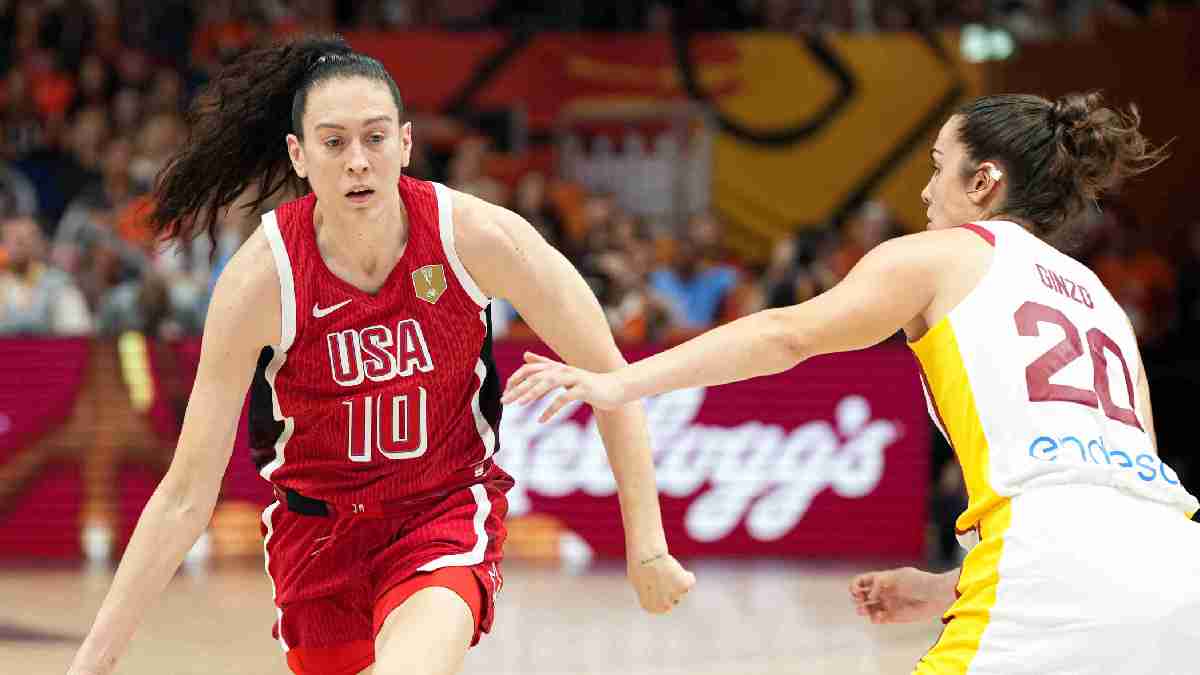
After battling through three uneven quarters, the Americans took control in the fourth and pulled away from Spain for a 76–66 victory Saturday in the FIBA Women’s Basketball World Cup semifinals.
Breanna Stewart scored a team-high 16 points and Kahleah Copper added 13 as the United States advanced to face France in Sunday’s championship game (1:45 p.m. ET, TNT). The matchup is a rematch of the 2024 Paris Olympics gold medal game thriller, which the Americans won 67–66.
Saturday's victory extended Team USA’s World Cup winning streak to 35 games, dating to its 2006 semifinal loss to Russia. The Americans, who improved to 6-0 against Spain in World Cup competition, are one victory from securing a fifth straight championship, which would match the former Soviet Union’s record for most consecutive titles.
IT ALL COMES DOWN TO THIS 🇺🇸🇫🇷 #FIBAWWC pic.twitter.com/H57WN5C3Cx
— FIBA Women's Basketball World Cup (@FIBAWWC) September 12, 2026
Spain immediately demonstrated that this would not resemble the United States’ record-setting 108–56 quarterfinal rout of Hungary. The Spanish scored nine of the game’s first 10 points and eventually built a 16–9 advantage, the largest deficit Team USA had faced during the tournament.
America’s second unit changed the energy, applying full-court pressure and producing a 12-2 run to close the opening quarter with a 21-18 lead.
Spain’s physical defense prevented the United States from developing a consistent offensive rhythm in the second quarter. The foul line kept the Americans ahead, helping them carry a 39-36 advantage into halftime.
Spain continued its attack after the break, outscoring the United States 22-19 in the third quarter to tie it at 58 after 30. Iyana Martín, María Conde, and Awa Fam spearheaded Spain’s fearless effort while its guards repeatedly penetrated and challenged the American defense.
The upset bid ended early in the fourth. Stewart, Copper, Jackie Young, and Aliyah Boston helped Team USA score 12 of the quarter’s first 14 points, producing a 70-60 advantage with 5:20 remaining. Spain never pulled closer than eight again.
That's just beautiful basketball.#FIBAWWC pic.twitter.com/EyIJcUDo3l
— FIBA Women's Basketball World Cup (@FIBAWWC) September 12, 2026
“I think that when you have so many great players, it’s like everybody needs to be their best,” Stewart said. “You need to be yourself, and a great player knows to play with other great players. So I think that when we see who’s got a role, we just continue to feed them the ball and be confident.”
Team USA also finished with a 36-32 rebounding advantage, including a 30-23 edge on the defensive glass, and blocked four shots. Spain recorded more assists, 15-12, but committed 16 turnovers to the Americans’ 14.
Spain will face host Germany in Sunday’s bronze-medal game (10:15 a.m. ET, TruTV).
Stewie Knew The Assignment
When the Americans needed someone to take control, Stewart accepted the responsibility. She changed the game with her activity late in the third quarter and early in the fourth, attacking the paint, collecting rebounds, disrupting passing lanes, and using her length to generate deflections.
Without A’ja Wilson available, Team USA needed the 2018 FIBA Women’s World Cup MVP to become its most authoritative voice and dependable presence. She led through both communication and action, showing her younger teammates she wouldn't demand anything she wasn't willing to provide herself. When Stewart raised her intensity, the other veterans followed.
STEWIE IS HER 🇺🇸🔥 #FIBAWWC
16 PTS | 6 REB | 2 AST pic.twitter.com/O5sFRC3XLh
— FIBA Women's Basketball World Cup (@FIBAWWC) September 12, 2026
Copper attacked closeouts and converted difficult baskets, while Young and Chelsea Gray helped steady the Americans during the decisive stretch.
Stewart’s impact was equally important defensively. Her scoring and ability to draw fouls allowed Team USA to set its defense instead of scrambling in transition. Spain entered the final period with momentum, but Stewart’s leadership helped the Americans regain control and close with composure.
USA’S Bench Changed The Tempo
Spain’s aggressive opening forced Team USA into unfamiliar territory. The Americans struggled to contain penetration, their half-court offense became stagnant, and Spain dictated the physical tone. Coach Kara Lawson’s second unit changed that dynamic by increasing the defensive pressure and creating open-floor opportunities.
Paige Bueckers immediately turned a steal into a transition layup, while Rhyne Howard picked up full court and stretched Spain’s defense with her perimeter shooting. Boston supplied interior energy, and Angel Reese attacked the offensive glass.
There When It Mattered
The reserves did not dominate the final box score but their early contribution prevented Spain from establishing complete control. More importantly, it revealed Team USA’s clearest tactical advantage: depth. Lawson could introduce fresh defenders, pressure Spain’s ballhandlers, and accelerate the game without sacrificing size or athleticism.
That depth became particularly important because Caitlin Clark struggled offensively, finishing with one point and missing all three of her attempts from beyond the arc. The reserves stabilized the Americans long enough for the veterans to finish the job.
“I mean, that’s what great teams do,” Copper said. “Despite whatever’s happening in the game or whatever is not going your way exactly, you find ways to win, and I think that’s just what we did. I think we got better as the game went on. I think the first half wasn’t great, but we put heavy emphasis on coming back out there and playing harder.”
Offense Must Improve Against France
Team USA survived through defense, physicality and free-throw volume, but its offensive performance raised serious concerns entering the championship game.
The Americans shot only 40% overall, made 3 of 18 shots from beyond the arc and recorded just nine points from 3-point range. They also produced only a dozen assists.
The foul line concealed many of those deficiencies. Team USA converted 27 of 35 free throws, including 19 of 27 during an opening half in which it made only nine field goals. Spain’s 23 fouls repeatedly rescued American possessions that generated limited movement or few clean shooting opportunities.
Neither team shot effectively from outside, as Spain finished 6 of 26 from long range. The Americans compensated by making 20 of 40 shots inside the arc. Spain converted 19 of 40 two-point attempts but went to the foul line only 11 times, making 10.
N'essaie même pas!
"Don't Even Try It!"
France won't give the Americans the same margin for error. The French advanced with an 86–64 semifinal victory over host Germany, led by defensive specialist Gabby Williams’ 22 points. They possess the length, discipline and perimeter firepower to punish empty possessions.
The United States must generate quicker ball reversals, improve its spacing and convert open perimeter opportunities. Its defense remains championship-caliber, but another 16.7% performance from long distance could allow France to complete the upset it missed by inches in Paris.
Marine Johannes and Gabby Williams attack the rim late in 4Q!#FIBAWWC pic.twitter.com/H2QyqNW6hi
— FIBA Women's Basketball World Cup (@FIBAWWC) September 12, 2026
“This is going to be challenging and obviously we got the biggest one tomorrow,” Stewart said. “But that’s why we’re here. We’re going for gold, and that’s what we’re going to do.”
W.G. Ramirez is a veteran sports writer from Las Vegas and a Staff Writer at Ballislife.com. Follow him on X at @WillieGRamirez.