

The WNBA playoffs are often framed around scorers, but championship series can turn on the defender who erases an opponent’s first option, closes a driving lane or finishes a possession with a rebound. Offenses become more deliberate, rotations tighten and teams hunt perceived weaknesses. A defender who survives those searches can alter a series without shooting.
The most valuable playoff defenders do more than accumulate steals and blocks. They communicate coverages, navigate screens, recognize actions before they develop and recover to correct a teammate’s mistake. Their versatility determines how aggressively a coach can switch, trap or protect the paint. They must defend without fouling because one whistle can disrupt a rotation or change the final minutes of a close game.
When One Stop Can Change A Series
This ranking weighs individual disruption, positional flexibility, defensive rebounding, rim protection and the ability to handle demanding postseason assignments. Playoff value also depends on whether a defender can repeat those responsibilities against the same opponent for multiple games. Familiarity creates counters; elite defenders must keep answering them.
Gabby Williams and Veronica Burton lead the WNBA’s best perimeter defense. Angel Reese changes Atlanta’s possessions through rebounding and physicality. A’ja Wilson remains the league’s most reliable interior eraser, while Alanna Smith offers rare coverage versatility if healthy. Each influences defense differently, making comparison difficult. Yet when a playoff game slows into a half-court test, these five defenders are best equipped to change what the opposing offense is allowed to run. Stops become championship currency.
Their influence grows clearer with every adjustment.
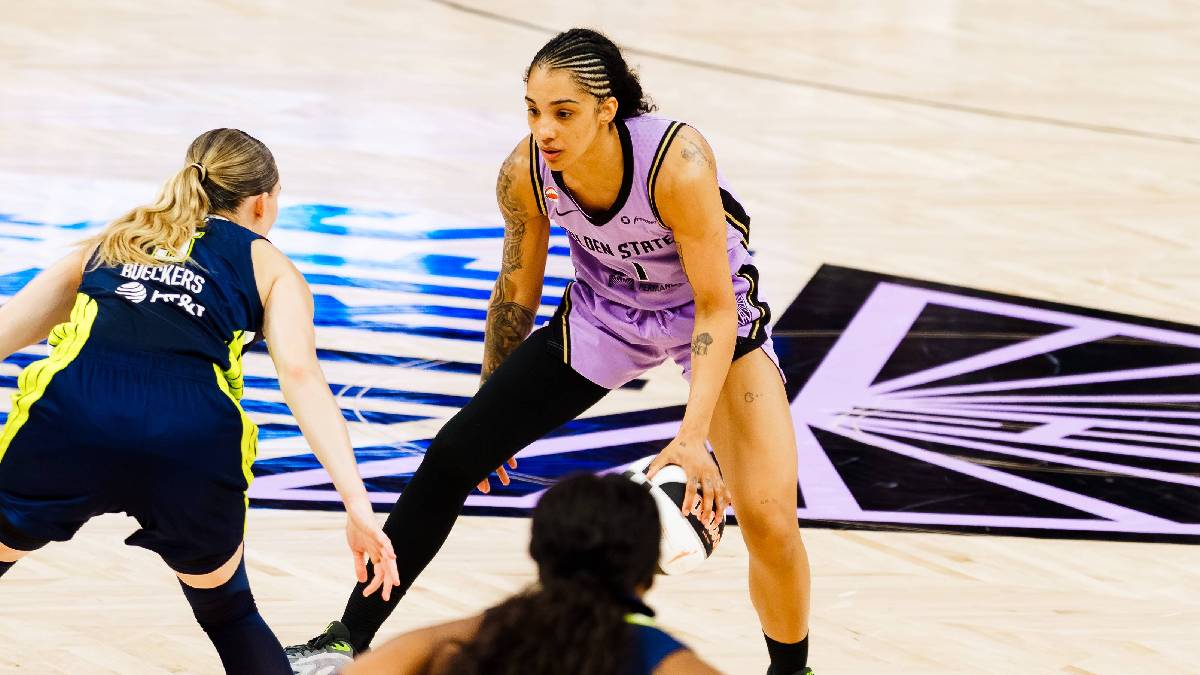
1. Gabby Williams, Golden State Valkyries
Williams enters the postseason as the league’s most complete perimeter defender and the betting favorite for Defensive Player of the Year (-110 at DraftKings). She combines the speed to pressure lead guards with strength and length to absorb bigger wings, allowing Golden State to change assignments without changing coverage. That flexibility is essential during a series, when opponents screen until they create the matchup they want.
Williams has appeared in 38 games and averages 1.7 steals in 25.2 minutes. Her 98.8 defensive rating reflects her influence within the top unit, but the larger value is how often her pressure accelerates an opponent’s decision. Williams crowds dribblers, attacks exposed handles and turns deflections into transition opportunities before a defense can organize. She returned from post-World Cup rest Tuesday and played 40 minutes against Portland, recording two steals.
Williams’ postseason assignment will likely change from possession to possession. She can chase shooters through off-ball screens, switch onto primary creators or deny an initiating pass entirely. That range reduces the hiding places an offense can find. Golden State has several defenders, but Williams brings the aggression that defines its identity. Against an elite perimeter scorer with the game on the line, she remains the first choice.
Superhero senses. All-Star activities. Gabby Williams ➡️ Kaitlyn Chen.@ampm | Assist of the Game pic.twitter.com/2g872hRM6C
— Golden State Valkyries (@valkyries) July 21, 2026
2. Angel Reese, Atlanta Dream
Reese’s defensive value begins with the simplest requirement: she ends possessions. Her 12.1 rebounds per game include 7.3 on the defensive glass, preventing opponents from turning an initial stand into another scoring opportunity. That skill becomes important in the playoffs, when pace slows, misses carry greater weight and one offensive rebound can determine a game.
The broader numbers describe a larger impact. Atlanta’s defense has been approximately 14 to 15 points per 100 possessions better with Reese on the court, the league’s strongest defensive on-off swing. Opponents’ effective field-goal percentage drops sharply during her minutes. Those results reflect more than rebounding. Reese can switch onto wings, crowd drivers with her length and generate turnovers with active hands. After Wednesday's win in New York, she was averaging 1.8 steals and 0.7 blocks while playing all 43 games.
Reese is not a stationary rim protector, and that distinction works in Atlanta’s favor. She wins through mobility, anticipation and effort, often recovering after containing the first action. Her physicality can invite foul trouble - he averages 3.7 fouls - but it also prevents opponents from becoming comfortable around the lane. In a postseason series, Reese’s motor creates cumulative pressure. Every contested catch and secured rebound forces an offense to begin again.
And when you mention dominant you better mention Angel Reese 😤
Not only does she swat the shot, but she converts on the other end. Then she leads Allisha Gray into an and-1 triple!
CHI-ATL | Prime Video | 2026 Postseason Push | @DKSports
Tap to watch: https://t.co/AhJMUtiW0k pic.twitter.com/EAdpinGERw— WNBA (@WNBA) September 20, 2026
3. A’ja Wilson, Las Vegas Aces
Wilson remains the defender to trust when the decisive possession moves toward the basket. Her timing, reach and vertical discipline allow her to challenge finishes without surrendering free throws, while her mobility prevents offenses from neutralizing her through high screens. She can drop, hedge, switch onto a guard and recover to the rim before completion.
Heading into the regular-season finale, Wilson is averaging 2.0 blocks and 1.4 steals while committing 1.9 fouls per game. Her 103.7 defensive rating reinforces how she anchors Las Vegas despite carrying the league’s heaviest offensive burden. She does not need to chase every block. Often, her presence changes the attempt before release, pushing drivers into floaters, rushed passes or retreat dribbles that allow the defense to reset.
Wilson’s playoff experience sets her apart from other candidates. She recognizes tendencies, communicates the rotation and understands when to challenge vertically rather than gamble. That judgment becomes crucial late, when one foul or missed assignment can decide a season. Her rebounding completes the stop, with 7.6 of her 9.4 boards coming defensively. Williams is the choice against a perimeter star, but Wilson is the defender to select when one possession must be protected from the paint outward. She remains the postseason’s interior standard.
Reminder: 4x MVP A'ja Wilson not only has 4 of the top 7 scoring seasons ever, she won 3 of the last 4 Defensive Player Of The Year awards! pic.twitter.com/RsqTIywXPa https://t.co/jvplfiQoDV
— Ballislife.com (@Ballislife) September 21, 2026
4. Veronica Burton, Golden State Valkyries
Burton gives Golden State a second perimeter stopper, but her profile differs from Williams’. Burton specializes at the point of attack, applying ball pressure before an offense can enter its action. She slides over screens, recovers from contact and stays active without compromising the structure behind her. The result is delayed initiation and fewer comfortable possessions for opposing guards.
The Valkyries have posted a 98.6 defensive rating with Burton on the floor, a number among the league’s best. She has started 43 games and averaged 1.6 steals and 0.5 blocks. Burton has blocked Caitlin Clark four times this season, evidence that her contests remain effective against larger or high-release creators rather than players her size.
Her postseason importance extends beyond forcing turnovers. Burton can pick up full court, fight to stay attached through multiple actions and funnel ballhandlers toward Golden State’s interior help. Because Williams can handle bigger wings, Burton can focus on the quickest initiator, giving coach Natalie Nakase two different pressure points. That pairing can exhaust a backcourt during a series. Burton may not draw the attention traditional rim protectors do, but few defenders disrupt an opponent’s timing as early or as consistently.
"I set the tone with my defense. It starts with me."
Veronica Burton joins the #WNBAonPrime crew after her 25-point, 5-block performance pic.twitter.com/ntvzeKvdOz
— Sports on Prime (@SportsonPrime) May 29, 2026
5. Alanna Smith, Dallas Wings
Smith’s place on this list depends upon her health. The reigning co-Defensive Player of the Year has been sidelined by a lower-left-leg injury suffered during the FIBA World Cup and had not returned through Wednesday. A postseason comeback remains possible, but Dallas cannot assume she will immediately handle her workload or move with her customary range. Nevertheless, she belongs on this list.
When available, Smith gives the Wings a structure they cannot duplicate. She can meet ballhandlers above the foul line, retreat with rollers and recover toward shooters without abandoning the basket. That mobility permits Dallas to vary its pick-and-roll coverage instead of leaving the same answer on film throughout a series. Smith also communicates early, positioning teammates before an advantage develops.
Her modest season averages - 0.7 steals and 0.5 blocks in 17.9 minutes - reflect an injury-interrupted campaign and reduced role, not the full scope of her defensive ability. Dallas has posted a 105.9 defensive rating in games she has appeared, and the roster has often looked more vulnerable when its mobile back-line organizer is unavailable. Smith’s value is partly schematic: she expands what Dallas can call. If her leg responds, she can switch, hedge or protect the rim. If not, the Wings lose their most versatile frontcourt defender.
Alanna Smith - Capitaine de la défense...
Ici GS joue son play favoris avec un DHO entre guards (VB et Gabby). Gabby arrive avec de la vitesse et déborde Paige mais Alanna a tout vu et vient faire la rotation au panier -> turnover !! pic.twitter.com/Jz4rOjUVZS
— Ghislain (@GhislainClement) August 18, 2026
W.G. Ramirez is a veteran sports writer from Las Vegas and a Staff Writer at Ballislife.com. Follow him on X at @WillieGRamirez.
Editor's Pick
 Ballislife Redemption Main Card Preview