What a year Sue Bird has had, from being inducted into the Naismith Basketball Hall of Fame to taking over the USA Women’s National Team as Managing Director.
She also had her jersey number (No. 10) retired by UConn last Sunday and became the first player in WNBA history to have a statue unveiled, courtesy of the Seattle Storm.
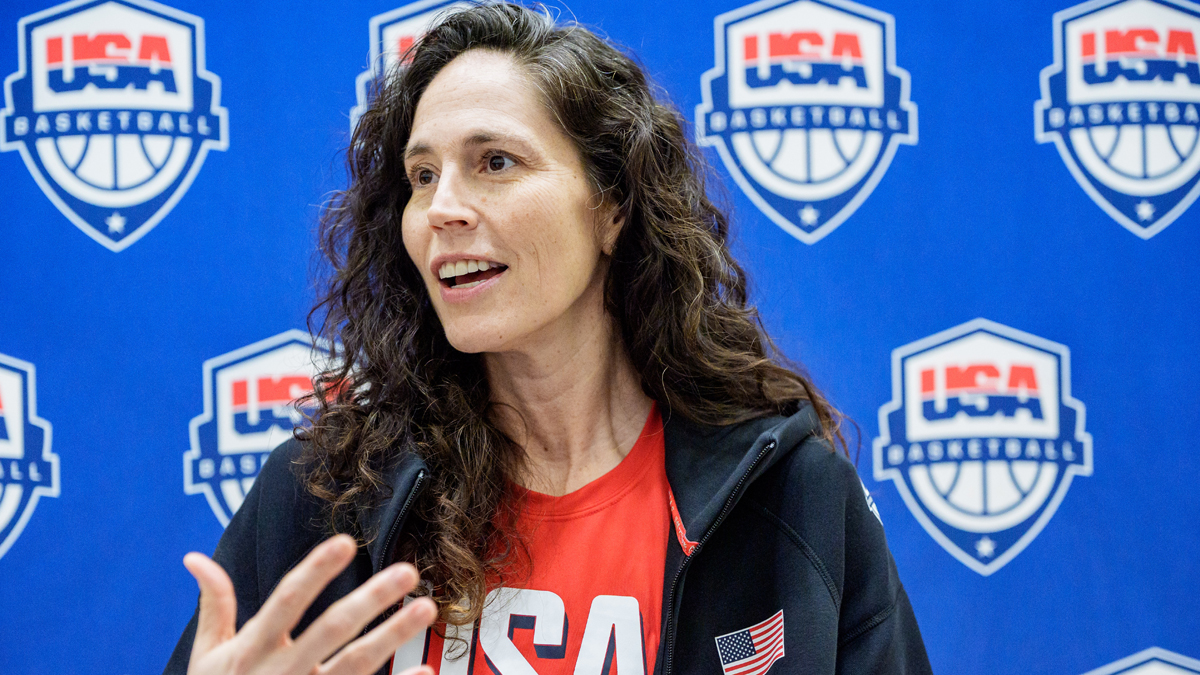
Bird got right to work, as she spoke to the media on Thursday about her approach as Managing Director of USA Basketball.
One of the ten new players she invited, USC Trojans star guard JuJu Watkins, is focusing on her recovery from a torn ACL while observing coach Kara Lawson‘s system throughout the training camp.
“I think it’s more about the exposure (to the game in general),” Bird said Thursday. “Even when you’re just around a team, it’s helpful, like something is building (and) something is happening there. So, it’s great for JuJu (Watkins), who’s obviously incredibly talented, (she) still has a couple of years (left) in college. I know she wants to finish that off, but to get her used to what the national team is, used to being around these players, and then, of course, the coaching staff.”
Throughout her playing career with Team USA, Bird won five Olympic gold medals and played alongside present and future Hall of Famers, such as Lisa Leslie and Dawn Staley.
Only one has won six gold medals, her longtime teammate and best friend, guard Diana Taurasi, who retired in February.
Bird is in her third year of retirement after her 19-year playing career, where she led the Seattle Storm to four championships and became the WNBA’s all-time leader in assists with 3,234.
Bird became a part-owner of the Seattle Storm in 2024 and has been hosting podcast shows, A Touch More and Bird’s Eye View. She added a new role to her resume in May: USA Women’s National Team Managing Director.
A full circle moment 🙌
— WNBA (@WNBA) December 12, 2025
Sue Bird sounds off in her new role as Managing Director for the #USABWNT! pic.twitter.com/RGS5EUezGK
“I definitely had some moments like, ‘Oh. I’m not a player anymore, this is totally different. Oh, I kind of have to wear all my team and shoot stuff.’ Now, it’s totally different,” Bird said. “But for the most part, it’s been great. Everybody with USA Basketball has been super helpful. As the managing director, I did my first part, which was hiring Kara (Lawson). … So in a sense, in this camp, I obviously want to be here, present, (and) watching everything. It’s a perfect little segue into this role for me.”
One of Bird’s first moves was bringing in Duke University’s Kara Lawson as head coach. Bird and Lawson were teammates on past Olympic teams.
Throughout the years, the USA Women’s National Team has contained veteran players who played at a high level for a long time.
“Something that definitely stuck out to me as I was thinking and looking, was that for really long time, our vets on the team were in the guard spots,” Bird said. “And now, if you look at the past Olympic team, you’ve got A’ja (Wilson), Napheesa (Collier), and Stewie (Breanna Stewart) and they’re kind of going to be like that. They’re gonna have the most gold medals. … It’s interesting. I was thinking back, it’s like, that actually hasn’t happened in a while.
“The last time that happened was the Lisa Leslie years, where she was always a vet, but she always had Dawn (Staley) on her side. So that stuck out to me the other day when I was thinking, but otherwise, it’s all the cycles have their own transition period.”
With the FIBA World Cup approaching in September, Bird and Lawson have time to decide on which of the players will participate on the USA Women’s National Team.
After the retirements of Bird and Taurasi throughout the 2020s decade, Team USA has entered a new era with players such as Paige Bueckers, Caitlin Clark, and Angel Reese as the faces of the team in the future.
“All the cycles kind of have their own, you know, like transition period. I think there’s some that are a little more glaring than others,” Bird said. “But they all have elements of that, where you want to have people who have been there, of course, but you also need to keep the pipeline going with the younger players and get them experience. That balance is always existing. It’s just sometimes it looks a little different. So we’ll see how this one shapes up.”